






Tourist shuttles and works vehicles
Battery packs for sightseeing cars, tourist shuttles and utility vehicles.
Three- and four-wheel low-speed vehicles run on 48, 60 or 72 V, and each class has its own lead-acid bank. The lithium pack that replaces it is sized from the vehicle's duty, not from the bank's amp-hour figure.
Platforms
Four platforms cover the low-speed vehicle classes.
String count is what decides which charger a pack talks to, so it is quoted alongside the voltage class. Each of these has drawings on file, in the capacity range shown.
| Class | Nominal voltage | String count | Capacity range |
|---|---|---|---|
| 48 V | 51.2 V | 16S | 200 – 1120 Ah |
| 60 V | 64 V | 20S | 314 Ah |
| 72 V | 73.6 V | 23S | 202 – 1120 Ah |
| 72 V | 76.8 V | 24S | 150 – 700 Ah |
Ranges are the capacities with drawings on file, not a promise that every value between them is stocked.
Which class
Read the lead-acid bank, and the class is already written on it.
Low-speed vehicles are built around a bank of 6 V blocks. Count them and the voltage follows, and the lithium replacement lands on one of the four platforms above.
48 V class
Replaced by a 51.2 V pack, 16 cells in series. The most common class in the register, and the one with the widest capacity range.
60 V class
Replaced by a 64 V pack, 20 cells in series. Usually a larger shuttle or a vehicle carrying more passengers than seats.
72 V class
Replaced by a 73.6 V or a 76.8 V pack — 23 or 24 cells. Which one depends on the charger already on the vehicle, so the charger is part of the enquiry.
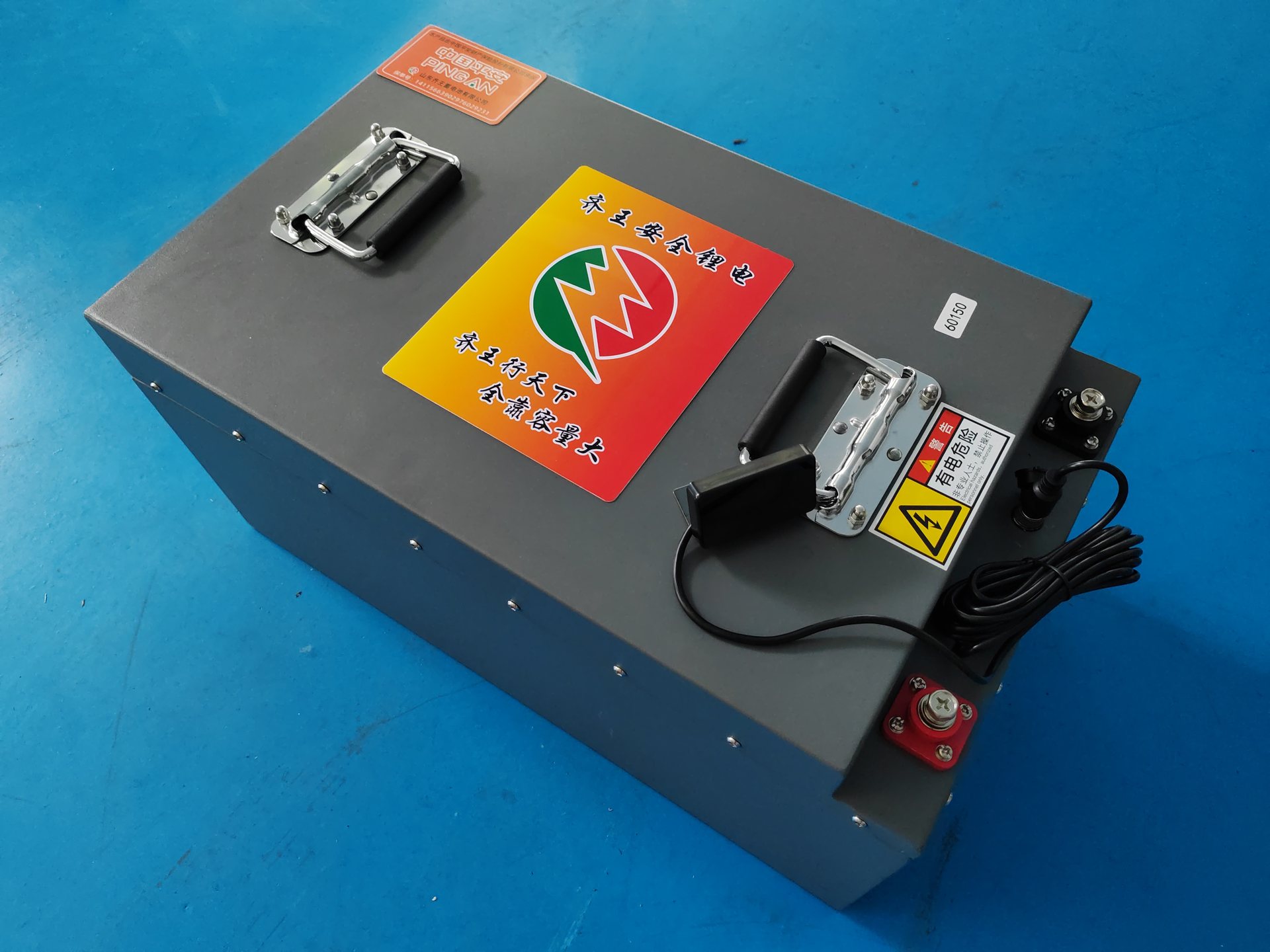
Built as one box
Six blocks become one pack, with the connector on the top face.
A single enclosure is what makes the conversion practical: fewer terminals to torque, one BMS, and a pack that can be lifted out for service instead of eight blocks being wrestled out one at a time.
Duty
A shuttle works a route, not a shift.
Sightseeing vehicles stop and start all day at low speed, with long idle periods between runs and a charger waiting at each end of the route. That pattern rewards a pack sized on energy per day with a charge window in the middle, rather than on the largest capacity that fits.
Opportunity charging
A pack that is topped up at each end of the route needs less capacity than one that runs the whole day on a single charge. Tell us the route length, the number of stops and where the vehicle stands between runs.
Weight and axle load
A lithium pack is lighter than the bank it replaces, which moves the centre of gravity. For a vehicle carrying passengers on an open deck, that is worth stating in the specification rather than discovering on the first run.
Where these go
The main market for this line is South America.
Tourist shuttles, resort vehicles and works vehicles in that market run 60 V and 72 V classes, and the packs ship as one box with the connector and charger matched to the vehicle. Documentation for the shipment is prepared before dispatch, and the export paperwork is the same set used for the forklift line.
Questions that come with the enquiry
What buyers ask before the first order.
Short answers, because the long ones depend on the vehicle.
Can the pack be built to the compartment we already have?
That is the normal case. Send the net length, net width and usable height of the compartment, plus the position of the old cable entries, and the pack is drawn to those numbers.
Does the vehicle need a new charger?
The charger is specified with the pack, because the string count decides the finish voltage. A 23S and a 24S pack are both 72 V class and neither will accept the other's charger.
What about the vehicles already running lead-acid?
The pack replaces the bank at the same system voltage and uses the vehicle's existing motor and controller. What changes is the charger, the weight, and the fact that there is one box instead of a row of blocks.
More from the plant
Where this sits on the site.
The same plant, the same cells, three other vehicle classes.
Floor equipment
Scrubber-dryers, sweepers and AGVs, 25.6 V and 51.2 V.
Next step
Send the bank, the route and the compartment.
Eight blocks or twelve, the route length, and three measurements — that is enough to come back with a drawing and a specification.