
Material handling · LiFePO4 traction
Forklift lithium batteries built to replace your lead-acid pack — and outlast three of them.
Prismatic LiFePO4 traction packs from 25.6 V to 96 V, sized against your duty cycle. Drop-in fitment for Heli, Hangcha, Linde, Toyota and Komatsu trucks, with 1–2 hour opportunity charging — no watering, no equalising, no battery room.
Free engineering tool
Size your forklift battery in four questions.
Answer four questions and the tool returns a voltage, a capacity, a discharge class and the thermal architecture the application calls for — then sends the configuration straight to our engineers.
Forklift battery selector
Indicative sizing from published Qiwang platform data.
Recommended configuration
Sizing is indicative. The final pack is confirmed against your duty-cycle data and truck dimensions before quotation.
Fitment database
Find the battery tray for your truck.
Search by truck brand and model, or by battery code. Every row is a tray we have dimensioned and built — 0 records across 14 truck brands. Send us the row and we will confirm the lithium equivalent, the connector set and the counterweight.
| Brand | Truck model | Battery code | Tray (L × W × H) | Assembled weight | Connector |
|---|
Standard platform
Three standard packs, and anything between them built to order.
These are the configurations we build most often for export. Each is a complete pack — cells, BMS, contactor, fusing, thermal management and enclosure — delivered ready to install with the connector set matched to your truck.
| Model | Nominal voltage | Capacity | Energy | Enclosure (L × W × H) | Typical fitment |
|---|---|---|---|---|---|
| QC-25.6V230AH | 25.6 V | 230 Ah | 5.89 kWh | 560 × 280 × 245 mm | 1–2 t counterbalance, single shift |
| QC-25.6V280AH | 25.6 V | 280 Ah | 7.17 kWh | 745 × 205 × 545 mm | Heli / Hangcha 1–2 t |
| QC-51.2V280AH | 51.2 V | 280 Ah | 14.34 kWh | 780 × 380 × 404 mm | Hangcha / Heli 2–5 t |
| QC-51.2V460AH | 51.2 V | 460 Ah | 23.55 kWh | 800 × 530 × 404 mm | 3–5 t counterbalance, multi-shift |
| QC-76.8V460AH | 76.8 V | 460 Ah | 35.33 kWh | 830 × 560 × 607 mm | Linde / Toyota 5–10 t |
| QC-96V400AH | 96 V | 400 Ah | 38.40 kWh | Built to order | 5–10 t high-voltage platform |
Light and mid counterbalance
25.6 V packs for 1–2 t trucks in single-shift warehousing, where a single pack covers a full shift with room to spare.
The workhorse
Our most specified export pack. Fits Hangcha and Heli CPD series compartments and most other 2–5 t platforms with minimal modification.
Heavy counterbalance
High-capacity pack for 5–10 t Linde and Toyota trucks, where duty cycles are long and discharge current is high.
Enclosure toolings in stock
Sixteen inner-box toolings are held across the 25.6 V, 48 V, 51.2 V, 73.6 V, 76.8 V and 80 V platforms, from 560 × 280 × 245 mm up to 900 × 560 × 610 mm. Where your truck tray matches a held tooling, a non-standard capacity does not mean a new tool.
Chargers and integration
Matched chargers and integration hardware are quoted with the pack, so the fleet does not end up sourcing them separately.
Engineering tiers
The same capacity can be three different packs.
Voltage and Ah are only the starting point. What separates a pack that survives five years from one that fails in two is discharge class, BMS topology and how heat leaves the cells. Below is how we configure a 3-tonne platform across three duty profiles.
| Parameter | Standard Duty | Heavy Duty | Multi-Shift Intensive |
|---|---|---|---|
| Typical application | Indoor warehousing, e-commerce fulfilment | Outdoor construction and logistics hubs | High-frequency multi-shift operations |
| Nominal voltage / capacity | 80 V / 200 Ah | 96 V / 400 Ah | 80 V / 304 Ah |
| Chemistry | LFP (LiFePO4) | LFP (LiFePO4) | LFP (LiFePO4) |
| Continuous discharge | 1.0 C / 200 A | 1.5 C / 600 A | 1.5 C / 456 A |
| Peak discharge (10 s) | 2.0 C / 400 A | 3.0 C / 1,200 A | 3.0 C / 912 A |
| Cycle life to 80 % SOH | 3,000 | 4,000+ | 5,000+ |
| BMS architecture | Passive balancing / CAN 2.0 | Active balancing / J1939 | Active balancing / predictive SOC–SOH |
| Thermal management | Forced air cooling | Liquid cold plate | Hybrid liquid / air |
| Operating temperature | −20 to +60 °C | −30 to +60 °C | −20 to +55 °C |
Why discharge class matters more than Ah
A 3-tonne truck draws its heaviest current during acceleration and mast lift. A pack rated for continuous 1 C but asked to deliver 2 C will sag under load, derate, and age quickly. We size the continuous and peak ratings to the truck, not to the label.
Why cell temperature delta is the real spec
LFP is thermally stable, but a pack is only as good as its weakest cell. We hold cell-to-cell temperature delta under 3 °C under load — the single largest lever on cycle life and on how evenly the pack ages.
Why active balancing pays for itself
Passive balancing bleeds energy to level cells; active balancing moves it. On multi-shift fleets that difference shows up as slower SOC drift, more predictable range and a longer service interval before any module replacement is needed.
How they are built
Module assembly, busbar welding and BMS integration under one roof.
Every traction pack is built from qualified prismatic cells, welded busbars and our own BMS stack, then cycled on the in-house bench before it is released for packing.
Inside the pack
Four subsystems we design and build ourselves.
Cells
Prismatic LiFePO4 cells, 180 Ah class and above, capacity- and resistance-matched into batches before assembly. Cells are stored and processed in a dedicated lithium workshop — 40 mu of the Linyi site is given over to lithium production alone.
BMS
Proprietary BMS stack with active cell balancing, SOC and SOH estimation, over-current, over-voltage and thermal protection. Communicates over CAN 2.0, J1939 or RS485 so the pack appears natively to the truck controller and to fleet management software.
Thermal management
Forced-air, liquid cold plate or hybrid liquid/air, selected against duty cycle and ambient conditions. Cold-store configurations add an integrated heating element so the pack can be charged safely below 0 °C without waiting for the truck to warm up.
Structure & sealing
Crush-resistant end plates, vibration-rated module stacking, nickel-plated copper busbars to hold internal resistance and oxidation down, and IP65 or IP67 enclosure sealing depending on whether the truck works indoors or outdoors.
From the production floor
Actual packs, across the enclosure formats we build.
LiFePO4 traction packs in the enclosure formats we tool in-house, ahead of packing and shipment.
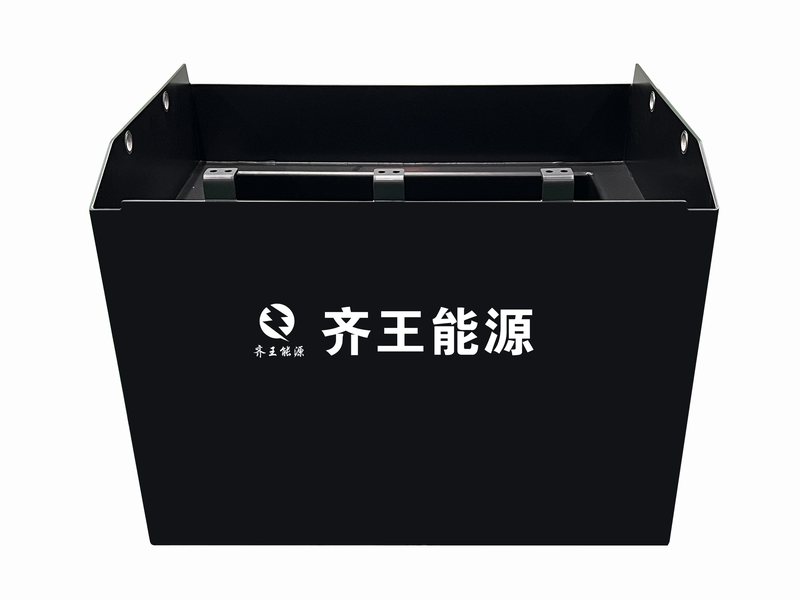
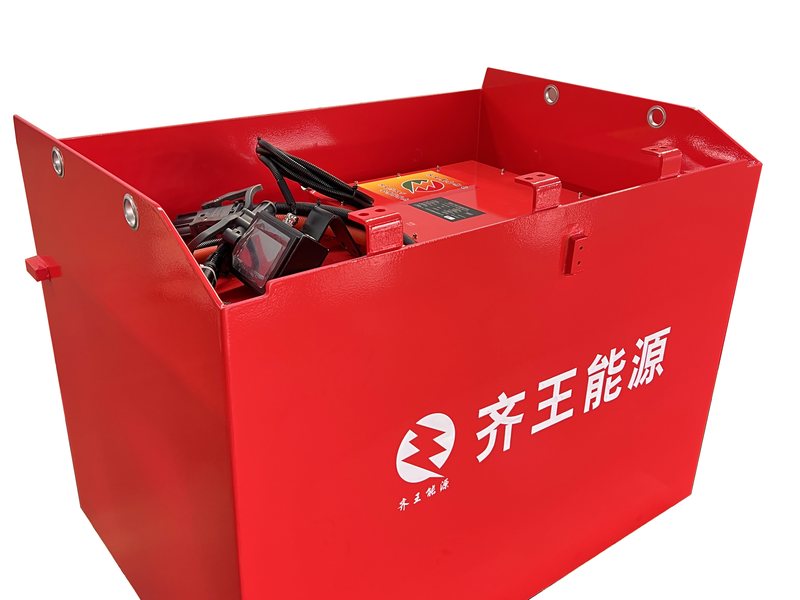
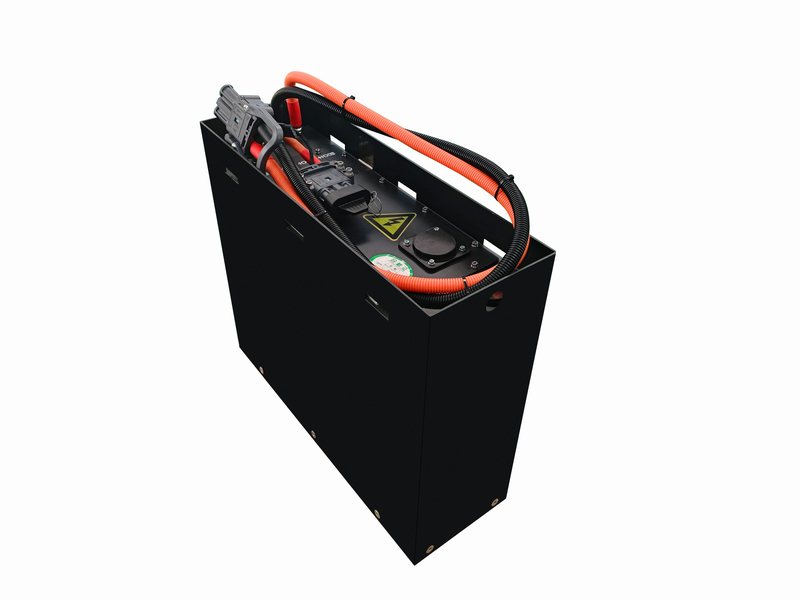
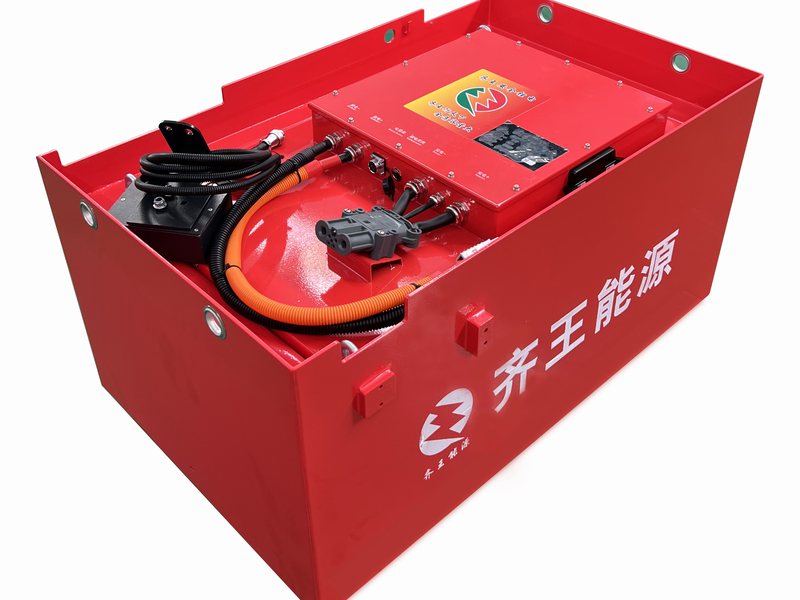
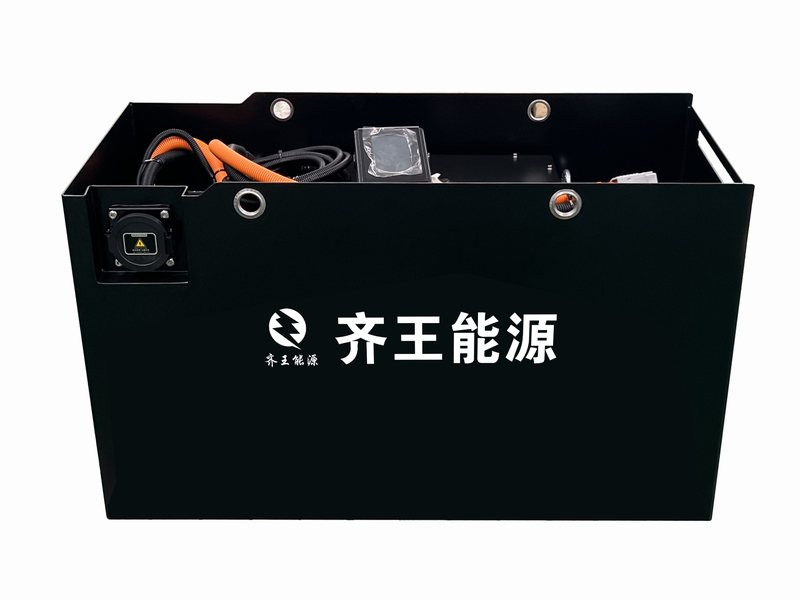
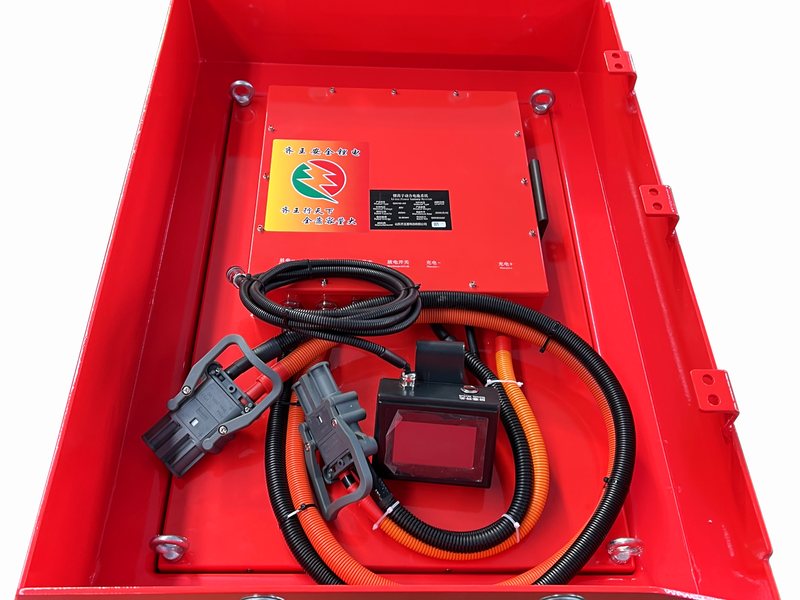
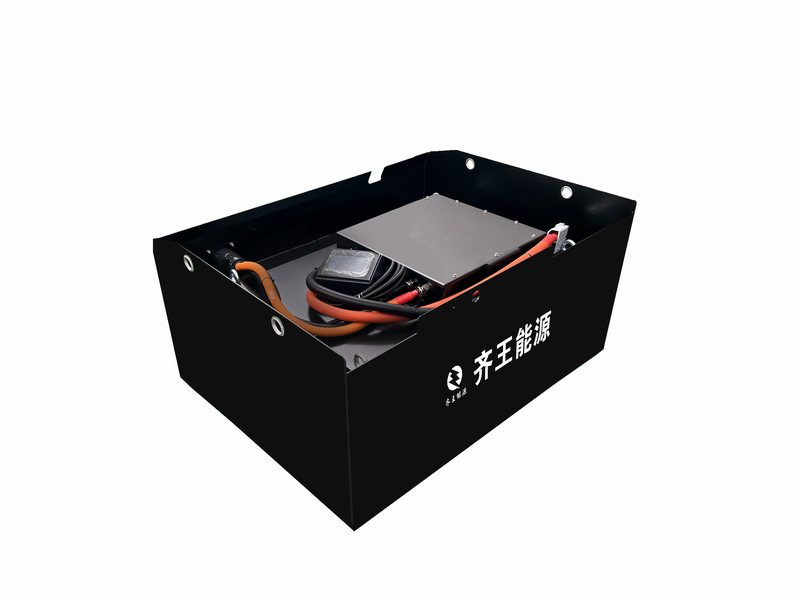
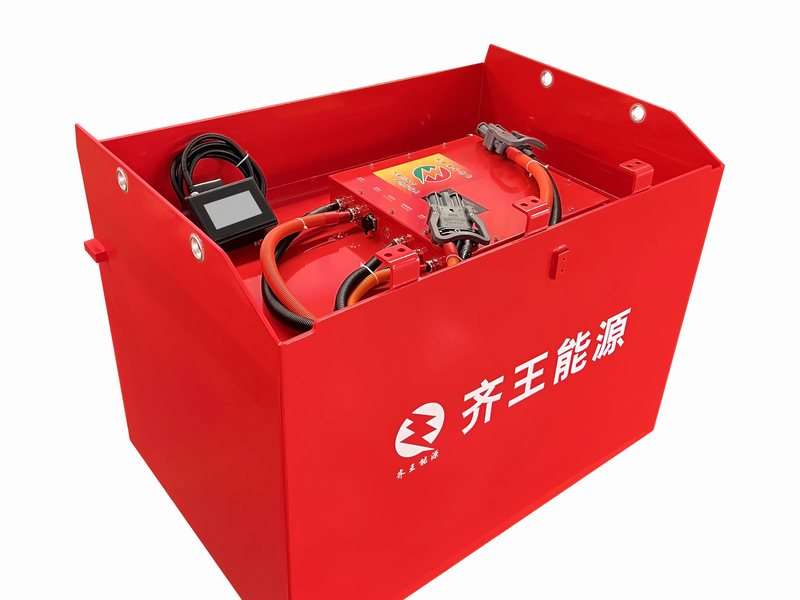
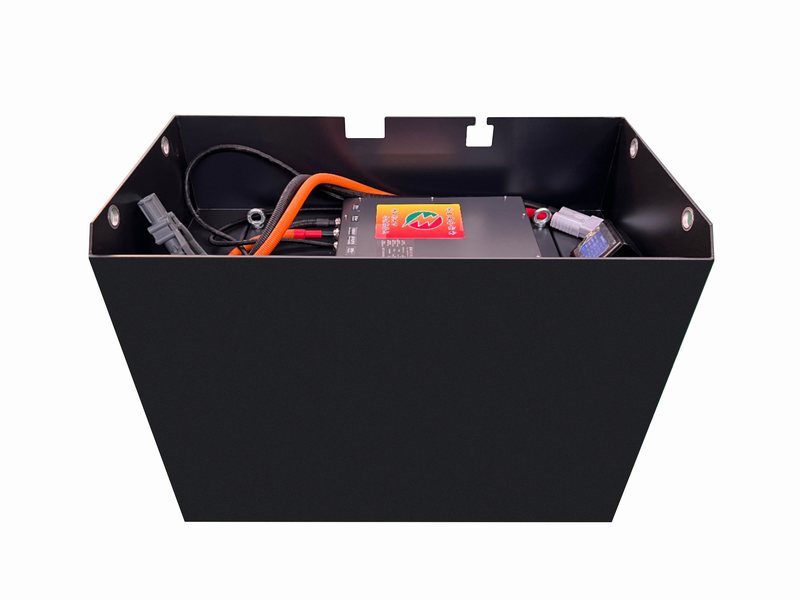
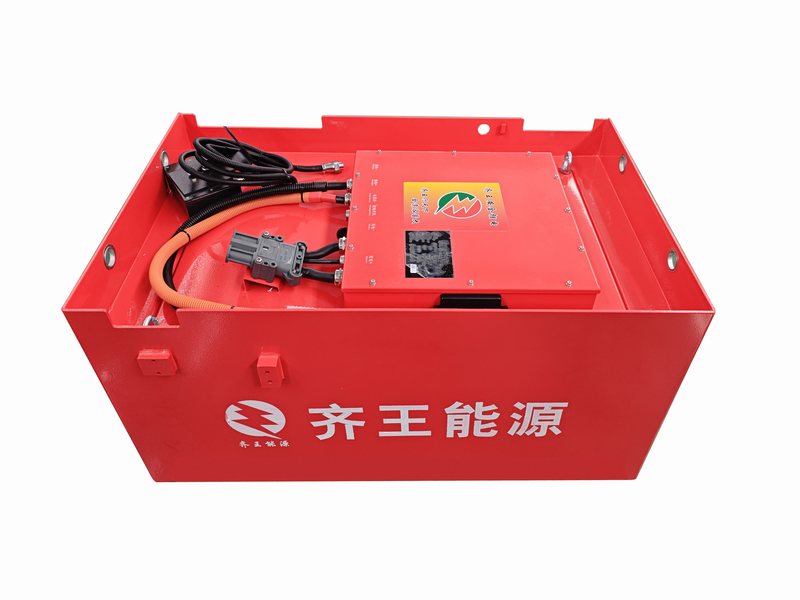
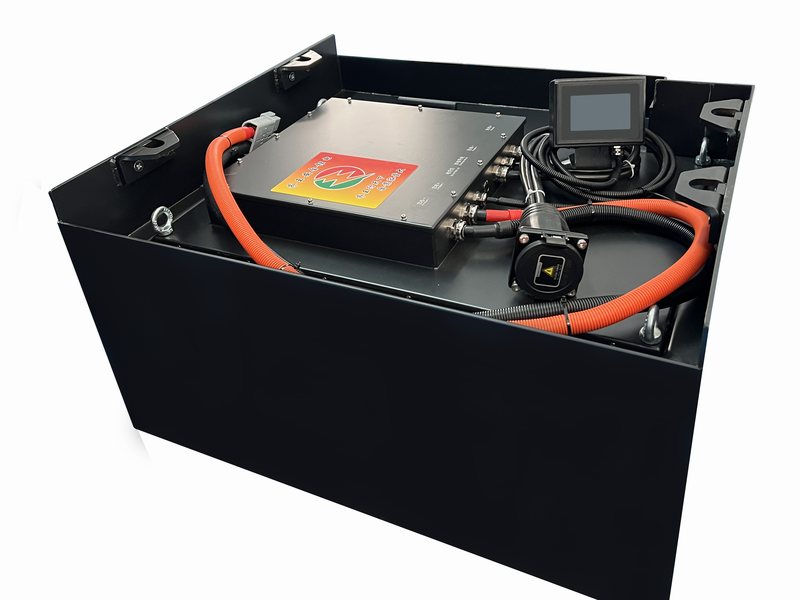
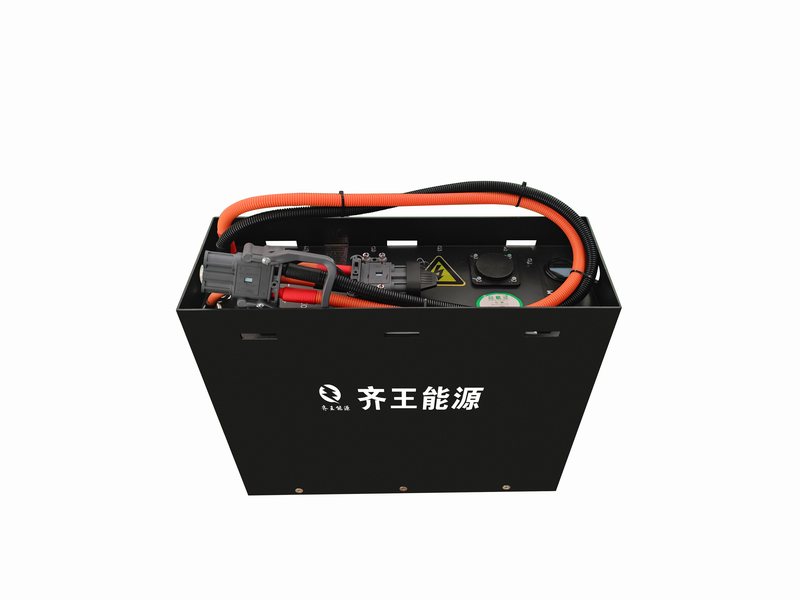
Enclosure formats, terminal layouts and connector sets can be specified per order under our OEM and ODM programmes.
The business case
Lead-acid or lithium — the comparison we quote from.
We manufacture traction batteries in both chemistries, so a fleet enquiry gets an engineering answer across both platforms.
| Parameter | Lead-acid traction | LiFePO4 traction |
|---|---|---|
| Cycle life | ≈ 1,000–1,500 cycles | 3,000–5,000 cycles |
| Service life in daily use | 2–3 years | 5–8 years |
| Maintenance | Watering, equalising, terminal cleaning | None |
| Charging | 8 h charge plus cool-down; battery room | 1–2 h, opportunity charging at break |
| Batteries per truck | 2+ for multi-shift operation | 1 |
| Ventilation and gas management | Dedicated, ventilated charging room required | Not required |
| Usable capacity | Reduced to protect against deep discharge | Deep-discharge tolerant |
| Operating cost | Baseline | Published saving of up to 50 % |
Fitment
Built to fit the trucks you already run.
Our packs are engineered as drop-in replacements for standard DIN traction compartments. Send us the truck model and the DIN designation on your existing battery and we will confirm the fitment, the connector set and the counterweight implications before you commit to an order.
What to send us for a firm quotation
Forklift battery questions
Answered by our engineering team
In most cases yes. Our standard packs are designed as drop-in replacements with minimal wiring modification, and where a standard DIN compartment exists we match its dimensions. Send us the truck model and the DIN designation on the old battery and we will confirm compatibility before quoting.
This is a real consideration and one we design for. Lithium packs are substantially lighter than the lead-acid blocks they replace, which changes the truck's centre of gravity. Where the difference matters we add ballast into the enclosure so the installed weight and balance stay within the truck's rated capacity.
Yes — a lithium pack needs a lithium charger with the correct voltage window and communication. We quote the matched charger alongside the pack so you are not left sourcing one locally. Many customers keep the lead-acid charger for a transition period while only part of the fleet is converted.
Standard configurations operate from −20 °C to +60 °C, heavy-duty outdoor configurations from −30 °C to +60 °C, and multi-shift configurations from −20 °C to +55 °C. Charging below 0 °C is not permitted on a bare LFP pack, which is why cold-store configurations include an integrated heating element.
By sea under IMDG rules, in UN-compliant packing with the UN38.3 test summary, MSDS and packing instruction. Product-level documentation covers IEC 62619 and CE. We prepare the paperwork before the container is loaded, so your customs broker is not chasing us for it.
Yes. Enclosure colour, label, connector set, BMS protocol and firmware identity can all be set to your specification under an OEM or ODM agreement, with tooling and first-article approval run against your drawing. NDA and design ownership terms are agreed before work starts.
Next step
Send the truck model. Get the pack specification.
Tell us what you run and how hard you run it. You will get a sized configuration, a dimensional drawing and a firm FOB or CIF quotation.